Lowrance Wireless Foot Pedal
A foot pedal for steering a trolling motor without looking down.
Overview
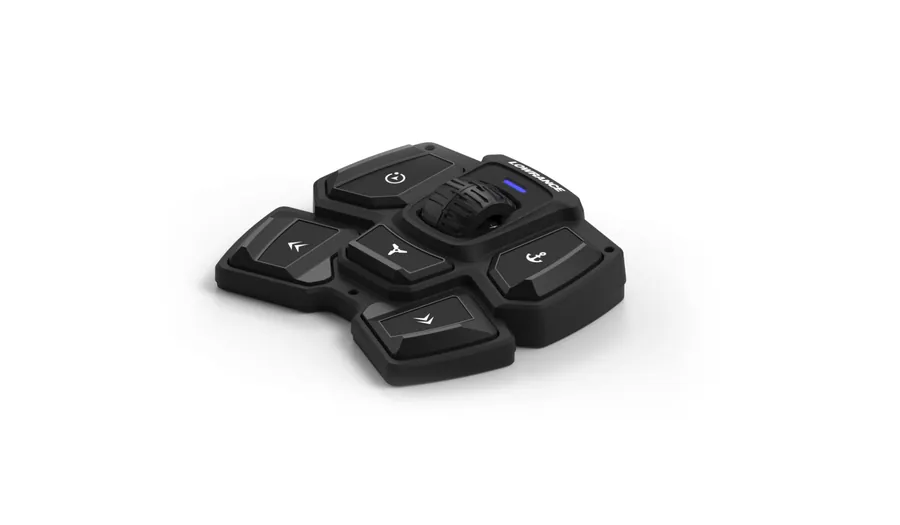
The Lowrance Compact Wireless Foot Pedal gives anglers hands free control of a trolling motor: steering, anchor lock, prop control and a speed wheel, with an LED indicator for feedback.
It lives on the floor of a boat or a kayak. It gets kicked, dragged and soaked, and it is used by someone who is watching the water, not their feet. Almost every detail in the design traces back to that.
Our Industrial Design team worked with engineering from the first research boards through to a detailed parametric CAD model.
Where it has to live
The work started with where the pedal would sit and who would be standing on it. Kayaks have almost no spare floor. Bass boats have a flat open deck. Walleye boats have higher sides and no recess for a pedal.
Mapping those layouts told us how big the pedal could be, how it might be fixed down, and how far a foot would have to reach. That research fed directly into the decisions that follow.
What came before
We looked at earlier foot pedals and at what they left unsolved: no visible sign of speed or power, and buttons that were easy to press by accident. We also mapped every part of the pedal, from throttle to waterproofing, to see where a known answer would do and where new concepts were needed.
Sketching the layout
Sketching came next, quick and small, working through button counts and arrangements before anything went into CAD. The strongest ideas became a grid of concepts, and from there the form was refined in steps.
Shaped around the foot
The layout follows the way a foot pivots. With the heel on the deck, an angler can swing across the bottom three buttons, left, right and prop, without lifting the foot and without looking down. The outer buttons curve to follow that arc.
The buttons are tiered. The prop button in the middle is the one used most, so it is raised, and pressing it does not catch its neighbours. Seen from the side, the whole top surface is angled to match the natural movement of the foot. The part lines follow the same angle, so the engineering and the look agree with each other.
Part lines and draft
The pedal is two mouldings, an upper and a lower housing. Where they meet is a line the eye will always find, so we placed it on purpose. It runs at the same angle as the top surface and reads as part of the form.
Each housing also needs draft so it can release from its tool. We worked that draft into a chamfer around the base, so a moulding requirement became a design detail and not a compromise.
Prototypes and hinges
Printed prototypes went under real feet early. One showed the steering buttons needed support underneath, because pressing them made the whole pedal rock. That was cheap to learn in a print and expensive to learn later.
The buttons move on flexible hinges, so how long those hinges last decides how long the product lasts. We worked through the hinge design with the engineers, who tested it in analysis before anything was tooled.
Speed wheel and light
The speed wheel sits in the centre with an LED indicator above it. We tested the light on a bench rig before settling on how it should look, then drew the options over the render. The chosen version shows separate segments, where others tried to blend them into one bar.
The same light language runs across the wider family of Lowrance trolling motor controls, so the pedal had to fit a system and not only itself.
Edges and fixing
A pedal on a deck gets kicked and dragged. Keeping the outside edges smooth means there is nothing to catch on a shoe, a line or the boat.
Three screw holes fix it down for anglers who want it permanent. Their placement was worked out by drawing over the render, and the detail around each hole went through several versions.
The underside
The underside took as much thought as the top. Silicone feet are held in place by the assembly itself, and the base stays raised so nothing catches as the pedal slides across the floor. A tether point lets it be hooked to the boat so it cannot be lost.
The battery compartment had to be fully waterproof and tucked away from knocks. We sketched through doors, seals and catches before settling its position, then placed the product and certification labels around it.
Built to be built
The geometry is more complex than it looks. We built a detailed parametric model with the engineers, working top down from a shared skeleton, so that a change to the layout carried through every part.
Credits
Client: Lowrance.