Ironclad Fire Oven Set
Four pieces of cast iron that interlock to make six pieces of cookware.
Overview
Ironclad makes cast iron cookware in limited runs. For this set they worked with fire chef Lennox Hastie on one pot that could do the work of several: cook over open fire, sit on an induction hob, and replace a shelf of other pans.
Ironclad and Lennox had the concept. My job as the Industrial Designer was to make it real: the shape, the look, and how four separate castings lock together and come apart again. Having worked on other Ironclad projects, I carried the brand's motifs through into this one.
The answer is a pot, a lid that turns over to become a skillet, a trivet that doubles as a smoker, and one detachable handle that works on all of them.
What had to be true
Before any styling, the set came down to a short list of things that had to work.
- The lid turns over and nests inside the top of the pot.
- One handle fits every piece, and still attaches with the lid on.
- The handle goes on and comes off without fuss.
- Everything packs inside everything else.
- It works over open fire and on an induction hob.
How the parts fit together
Each piece has more than one job, so each has to sit with the others in more than one way. The lid sits on the pot as a lid, or turns over and nests into the top. The trivet goes under the pot or inside it. The handle hooks onto the pot, the skillet and the trivet, with the lid on or off.
Getting one of those right is easy. Getting all of them right with the same four castings is the design.
Shape
Two questions set the body. Should the rim carry a lip, and should the edges be chamfered or soft? A lip reads as traditional. No lip reads as more modern.
The taper was not a styling choice. The pot needs it to sit inside the lid. A subtle curve through the wall made the form look more considered than a straight side.
Fit, worked out in section
Four castings that nest and lock leave little room for error. Cutting through the CAD showed exactly where pot, lid and handle meet, and where the wall could be thick for heat and thinner where weight was not earning its keep.
One handle for every piece
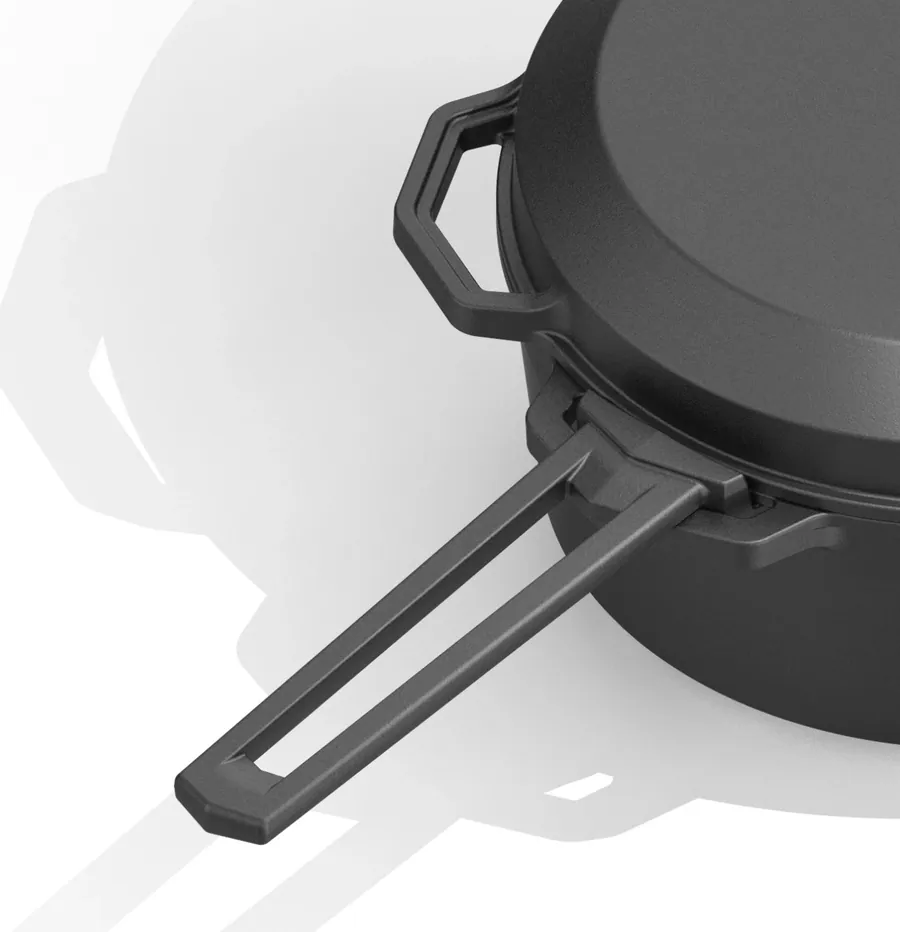
The handle was the hardest part. It has to lift a hot skillet, hook onto the pot, and still attach when the lid is on.
Most of that thinking happened by drawing straight over the renders and the CAD, marking what to change before changing it.
A thinner handle carries less heat to the hand, so the section stayed slim, then gained a little thickness where early versions looked too fine. The finished handle passes through the scoop of the pot's own handle, which is why it works in every orientation.
Ironclad's motifs
This was not my first Ironclad project, so the set picks up details from the rest of their range. The tree mark is cast into the handle and into the base, where it sits above the name of the collaboration.
Trivet and smoker
The trivet lifts the pot off the coals. Placed inside the pot it becomes a smoker. An early note on the board asked whether its pattern could echo wood: the rings inside a tree, a stack of twigs, or flame. The finished trivet is a set of rings.
From CAD to iron
I worked with Ironclad's founders and their suppliers through rounds of changes, checking that each casting could be made and that the parts still fitted once they were iron and not CAD.
The result is four pieces of recycled cast iron that make six pieces of cookware: a Dutch oven, a bread oven, a slow roaster, a smoker, a steamer and a skillet with a detachable handle.
Credits
Client: Ironclad. Designed with chef Lennox Hastie.